Fiberglass tanks are durable, corrosion-resistant and suitable for many storage applications. However, they are not immune to damage. Cracks, leaks, blistering and delamination can develop as a tank ages. Damage may also result from impact, movement, chemicals or poor support.
Some problems are relatively minor. Others can affect the structural integrity of the tank. The challenge is knowing the difference. A visible crack does not always show the full extent of the damage. Likewise, a leaking tank does not necessarily need complete replacement.
This guide explains common fiberglass tank problems and their causes. It also covers inspection, repair methods and repair-versus-replacement decisions.
It also explains what tank owners can safely check themselves and when professional inspection is necessary.
Can a Fiberglass Tank be Repaired?
Yes. Many fiberglass tanks can be repaired if the surrounding material remains in suitable condition. Fiberglass, also called fibreglass or GRP, consists of reinforcing glass fibres held within a resin matrix.
Because the material is built in layers, damaged areas can often be removed and rebuilt.
Common repairable problems include:
- Localised cracks
- Small leaks
- Damaged laminate
- Delamination
- Osmotic blistering
- Damaged gelcoat
- Leaking joints
- Problems around fittings
- Localised chemical damage
- Deteriorated internal surfaces
However, successful fiberglass tank repair depends on identifying the cause of the problem. Simply covering a visible crack may not provide a lasting repair.
For example, movement beneath the tank could cause repeated cracking. Moisture inside the laminate may result in further blistering. The condition of the surrounding laminate must therefore be considered before selecting a repair method.
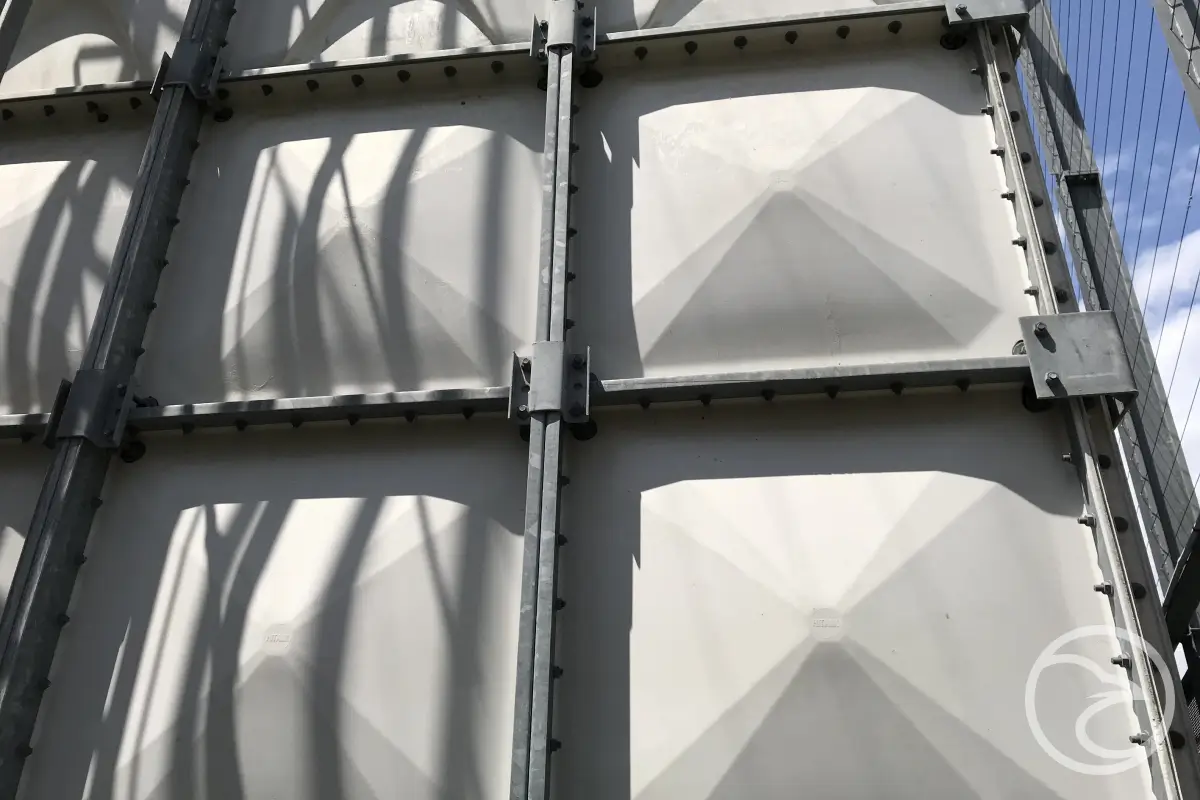
GRP water tanks use a sectional design that allows individual panels, joints and seals to be inspected, repaired or replaced when localised damage occurs.
What Causes Fiberglass Tank Damage?
Fiberglass tanks can deteriorate for several reasons. Often, more than one factor contributes to the problem. Understanding the cause is important because it influences the repair strategy.
Age and Material Deterioration
Fiberglass tanks can provide a long service life. However, their materials still change over time. Repeated loading, environmental exposure and operating conditions can gradually affect the resin and laminate.
Older tanks may develop:
- Surface cracking
- Reduced surface protection
- Localised laminate deterioration
- Leaks around connections
- Areas of delamination
Age alone does not mean a tank needs replacement. Its actual condition is more important than its installation date. Even minor water tank leakage should be investigated, as it may indicate damaged seals, cracking or deterioration within the tank structure.
UV Exposure
Outdoor tanks can experience years of ultraviolet exposure. The external protective layer helps shield the laminate from sunlight. When that layer deteriorates, the underlying material becomes more exposed.
Possible signs include fading, chalking, surface roughness and exposed fibres. UV deterioration may initially be a surface problem. However, prolonged exposure can contribute to more significant material degradation.
Impact and Mechanical Damage
Fiberglass is strong but can still be damaged by impact. Equipment, vehicles, dropped objects or maintenance activities can damage a tank wall.
An impact may produce an obvious crack. In other cases, the external surface may appear relatively intact. Damage can extend into deeper laminate layers.
This is why the area around an impact should also be assessed.
Poor Support and Movement
The base and supporting structure influence how loads are distributed through a tank. Uneven support can create localised stresses. Ground movement, foundation problems or changes in support conditions may also affect the tank.
Possible symptoms include:
- Recurring cracks
- Distortion
- Stress around connections
- Localised wall movement
- Leaks that return after repair
Repairing the fiberglass without correcting the underlying movement may only provide a temporary solution.
Repeated Filling and Emptying
Tank walls experience changing loads as liquid levels rise and fall. A correctly designed tank is intended to accommodate these loads.
However, repeated cycles can expose existing weaknesses. Areas around joints, fittings and previous repairs may be particularly important during an inspection.
Chemical Exposure
The stored liquid must be compatible with the tank’s resin and internal surface. Incompatible chemicals can attack the resin system.
Concentration and temperature can also influence chemical resistance. Signs of chemical deterioration can include softening, blistering, discolouration or loss of surface material.
A repair material must also be compatible with the tank’s intended contents.
Previous Repairs
Not every previous fiberglass repair performs well over the long term. Poor surface preparation can prevent new laminate from bonding correctly.
Other problems can include incompatible materials, trapped moisture and insufficient repair thickness. Repeated failure in the same location should therefore be investigated rather than simply patched again.
Common Signs a Fiberglass Tank Needs Repair
Tank damage does not always begin with a major leak. Small changes can provide an early warning.
Some of the most common signs include:
| What you notice | What it may indicate |
|---|---|
| Water or liquid around the tank | Leak, joint or fitting problem |
| Hairline cracking | Surface damage or laminate stress |
| Bulging or distortion | Structural or support problem |
| Blisters | Moisture or osmotic damage |
| Soft areas | Delamination or laminate deterioration |
| Exposed glass fibres | Loss of protective surface |
| Discolouration | Chemical or surface deterioration |
| Leaking fitting | Seal, connection or surrounding laminate problem |
| Repeated cracking | Movement or unresolved structural stress |
These signs should be treated as indicators rather than a final diagnosis. Several different problems can produce similar symptoms.
When visible damage goes beyond minor surface deterioration, professional water tank repair can help determine and implement the appropriate repair solution.
What Does a Crack in a Fiberglass Tank Mean?
Cracking is one of the most obvious signs of fiberglass tank damage. However, not every crack has the same significance. Some cracks affect only the outer surface. Others extend into the structural laminate.
A crack becomes more concerning when it:
- Continues to grow
- Returns after previous repair
- Leaks
- Appears near a fitting
- Occurs with bulging
- Has exposed fibres
- Is surrounded by soft material
- Appears in several nearby locations
The visible length of a crack does not necessarily show the complete damaged area. The laminate around it may also have been affected.
What is Fiberglass Delamination?
Fiberglass laminate contains multiple bonded layers. Delamination occurs when these layers begin separating from each other. The affected material can lose stiffness and strength.
Possible signs include:
- Soft or flexible areas
- Localised bulging
- Changes in surface shape
- Cracking
- Hollow sounds during appropriate testing
- Visible separation in damaged areas
Delamination can remain hidden beneath an apparently intact surface. For that reason, visual inspection alone may not establish its full extent.
What is Osmotic Blistering?
Blisters appear as raised areas on the fiberglass surface. They can develop when moisture moves through the resin and becomes trapped within the material. Over time, this process can create pressure within the laminate or protective surface.
A small number of superficial blisters may have limited significance. Widespread blistering can indicate a broader moisture-related problem. Blisters should not simply be covered without determining their cause.
Trapped moisture can remain beneath a new coating and contribute to further deterioration.
Can You Inspect a Fiberglass Tank Yourself?
A tank owner or facility manager can perform a basic visual inspection. This can help identify changes before they become more serious.
However, there is an important distinction between observation and technical inspection. A basic external inspection does not confirm structural integrity.
What Can You Check Yourself?
Start with areas that can be observed safely from outside the tank.
Look for:
- New cracks
- Wet patches
- Unexplained liquid around the tank
- Blistering
- Bulging
- Surface deformation
- Exposed fibres
- Damaged external coating
- Leaks around fittings
- Changes around joints
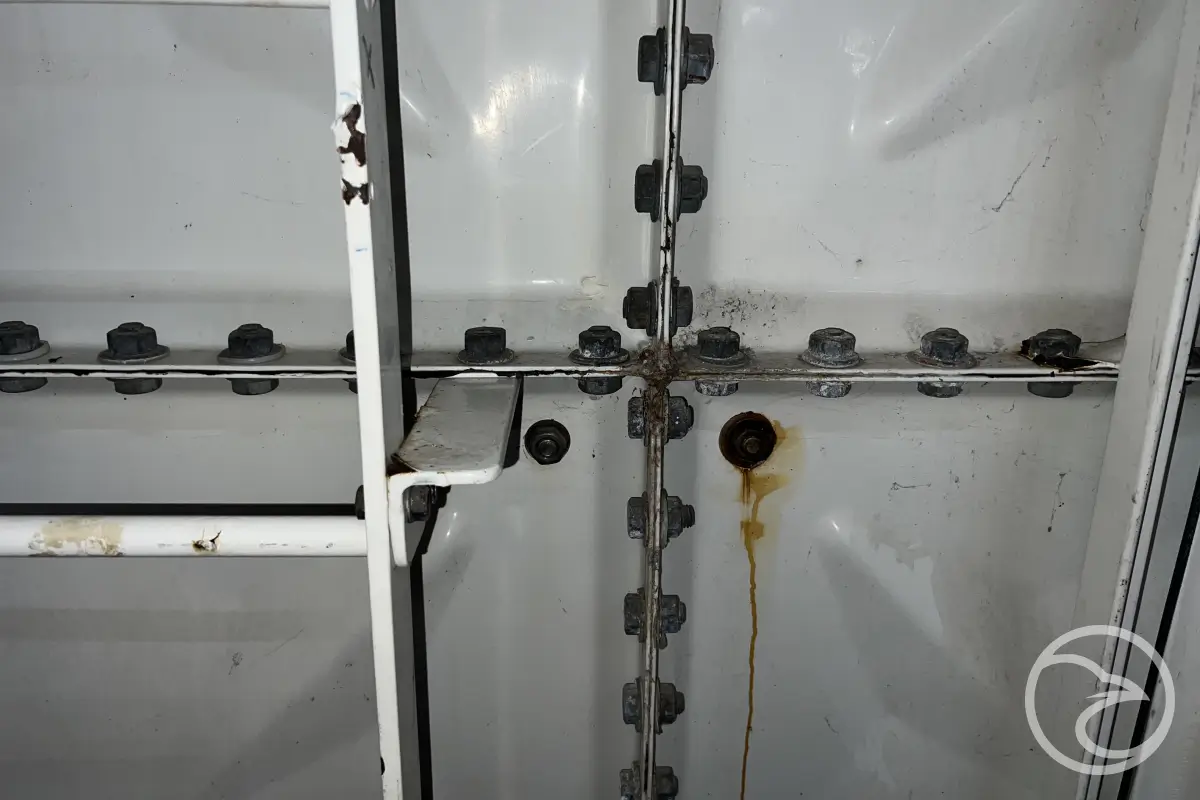
- Corrosion of connected components
- Damage around previous repairs
Compare current conditions with previous inspections where possible. Photographs can be useful for monitoring visible changes. Take images from a consistent position and record the date.
Also consider the operating behaviour of the tank. An unexplained reduction in liquid level may indicate leakage even when the leak is difficult to see.
When Should You Stop the Inspection?
Do not enter a tank simply because the inside needs checking. Tanks can present confined-space and atmospheric hazards. Additional risks may remain after the tank has been emptied.
A basic visual check should not involve:
- Confined-space entry
- Grinding fiberglass
- Cutting laminate
- Opening blisters
- Drilling the tank
- Removing structural material
- Repairing chemical tanks without suitable controls
These activities move beyond routine observation. Professional assessment may be necessary when the condition cannot be established safely from outside.
Surface Damage or Structural Damage?
One of the most important questions is whether damage is superficial or structural. Surface deterioration primarily affects the protective outer layer.
Structural damage extends into the laminate responsible for supporting loads.
Signs of Possible Surface Damage
Examples may include:
- Minor scratches
- Fading
- Light surface crazing
- Small areas of gelcoat deterioration
- Minor surface abrasion
Even these problems should be monitored. Damage to the protective surface can eventually expose the laminate underneath.
Signs of Possible Structural Damage
More concerning symptoms include:
- Deep cracking
- Broken fibres
- Significant delamination
- Bulging
- Deformation
- Soft wall sections
- Repeated leaks
- Movement around fittings
- Multiple failures in the same area
It is not always possible to determine damage depth from appearance alone. A small external crack may extend further into the laminate. This is one reason professional fiberglass inspection can be useful before structural tank repairs begin.
Professional tank refurbishment services can provide a cost-effective way to restore ageing or deteriorated tanks without proceeding directly to full replacement.
How are Fiberglass Tanks Repaired?
There is no single repair method suitable for every GRP tank. The correct approach depends on the defect, laminate condition and tank service.
The stored material must also be considered.
Crack Repair
The damaged area first needs to be assessed. A structural crack cannot simply be hidden beneath resin or coating. Damaged material may need to be removed until sound laminate is reached.
The laminate can then be rebuilt using compatible reinforcement and resin. The repaired area should restore the required structure and protective surface.
Fiberglass Laminating
Laminating is commonly used when damaged fiberglass needs structural rebuilding. New layers of reinforcement and resin are applied to a properly prepared surface. Preparation is particularly important.
Contamination, moisture or weak material can prevent proper bonding. The laminate design also needs to suit the original structure and service conditions.
Delamination Repair
Delaminated material cannot always be restored by covering its external surface. The affected area must first be identified.
Unsound laminate may need to be removed before the structure is rebuilt. The surrounding fiberglass should also be checked. Otherwise, the repair may bond to material that is already deteriorating.
Joint and Seal Repair
Sectional GRP tanks contain joints between panels. Leaks can develop when seals deteriorate or movement affects these connections.
A joint problem is different from a crack through a fiberglass panel. The source of the leak should therefore be confirmed before repairs begin.
Repairs Around Fittings
Nozzles, outlets and other penetrations create localised stress areas. A leak around a fitting does not always mean the fitting itself has failed.
The surrounding laminate may be cracked or weakened. Repair should consider both the connection and the structural condition around it.
Panel Replacement
Some sectional fiberglass tanks allow individual damaged panels to be replaced. This may be appropriate when one panel has significant damage while surrounding sections remain serviceable.
Replacement decisions depend on tank construction and overall condition.
Fiberglass Tank Relining
A fiberglass tank reline may be considered when deterioration affects a broader internal surface. Relining creates a new protective barrier inside the tank.
However, relining should not be used to conceal unresolved structural damage. The existing substrate needs to be suitable for the new system.
Moisture, contamination and deteriorated laminate can affect adhesion.
Surface and Gelcoat Restoration
Surface restoration may be suitable when deterioration is limited to protective layers. Damaged areas are prepared before a compatible protective system is applied.
This can help protect the underlying laminate from environmental exposure. It is different from structural laminate repair.
Why do Fiberglass Tank Repairs Sometimes Fail?
A repaired tank can develop the same problem again when the underlying cause remains unresolved. This often happens when attention is focused only on the visible defect.
Common reasons for repair failure include:
- Inadequate surface preparation
- Bonding to weak laminate
- Moisture beneath the repair
- Incompatible resin
- Incorrect curing conditions
- Continuing structural movement
- Unresolved support problems
- Active delamination
- Chemical incompatibility
- Insufficient repair area
- Repairing symptoms rather than causes
Consider a crack caused by foundation movement. Repairing the crack restores the damaged laminate, but it does not stabilise the foundation. The same stress may eventually affect the repaired area again.
The principle is simple: repair the cause, not only the crack.
Should You Repair or Replace a Fiberglass Tank?
Visible damage does not automatically mean a tank needs replacement. Likewise, repair is not appropriate in every situation.
The decision should consider the extent of deterioration and the tank’s intended service.
| Repair may be appropriate when | Replacement may be considered when |
|---|---|
| Damage is localised | Damage is widespread |
| Surrounding laminate is sound | Large areas are deteriorated |
| Tank shape remains stable | Significant deformation exists |
| Cause can be corrected | Underlying cause cannot be corrected |
| Individual components can be restored | Multiple areas repeatedly fail |
| Repair can restore required performance | Reliable performance cannot be restored |
The age of the tank is only one factor. An older tank with localised damage may remain repairable.
A newer tank with extensive chemical or structural deterioration may require a different approach. Condition should drive the decision.
How is a Fiberglass Water Tank Repair Assessed?
A leaking fiberglass water tank should first be assessed rather than immediately patched.
The basic process is:
- Identify the symptom. Determine whether there is cracking, leakage, blistering or another visible problem.
- Locate the affected area. The visible leak may not be the original point of failure.
- Assess surrounding material. Damage may extend beyond the obvious defect.
- Determine the likely cause. Consider impact, movement, ageing, fittings and previous repairs.
- Establish damage depth. Determine whether the problem is superficial or structural.
- Select the repair method. The repair should match the defect and tank construction.
- Restore protective surfaces. Structural laminate may require a suitable protective finish.
- Check the completed repair. The tank should be assessed before normal service resumes.
This is why “how to repair a fiberglass water tank” does not have one universal answer. A leaking fitting, surface crack and structural laminate failure require different solutions.
How can Future Fiberglass Tank Damage be Reduced?
Regular observation can help identify deterioration earlier. Tank owners and facility managers should pay attention to changes rather than waiting for a major leak.
Useful preventive measures include:
- Inspect visible surfaces periodically
- Investigate new cracks
- Monitor previous repair areas
- Check fittings and joints
- Watch for unexplained liquid loss
- Maintain suitable tank support
- Protect exposed surfaces
- Check chemical compatibility
- Record visible changes
- Investigate recurring problems
Small changes are easier to assess when previous condition records exist. Photographs and inspection notes can therefore be valuable maintenance tools.
Final Thoughts on Fiberglass Tank Repair
Fiberglass tank damage does not always mean the tank has reached the end of its service life. Many cracks, leaks, damaged joints and localised laminate problems can be repaired. The important step is identifying what caused the damage.
A visible defect may only be part of the problem. Cracking can result from movement, poor support, impact or deterioration within the laminate. This is why inspection should come before repair.
Tank owners can perform regular external visual checks. Look for cracks, leaks, blistering, bulging, exposed fibres and changes around fittings. Photographs and maintenance records can also help track deterioration over time.
However, visual inspection has limits. It cannot always show the depth of a crack or hidden delamination. Internal entry and intrusive inspection also require appropriate safety procedures.
When damage is found, the decision should not simply be whether to patch or replace the tank.